

2026 Budget: Arabic Education Board To Spend ₦2.5bn On Roads, Solar Streetlights, Food Distribution


The National Board for Arabic and Islamic Studies (NBAIS), a federal agency established to regulate and standardise Arabic and Islamic education in Nigeria, has earmarked over ₦2.5bn in its 2026 budget for road construction, solar streetlights, food distribution, and social media training.
This is despite its mandate is to regulate Arabic and Islamic education but plans to execute roads, solar streetlights, food distribution and other constituency-style projects across four states.
An analysis of the 2026 Appropriation Act by WikkiTimes shows that the projects are concentrated in Kano, Katsina, Kogi and Zamfara states. The projects have no connection to the Board’s statutory responsibilities.

The findings have renewed concerns over the persistent practice of inserting constituency-style projects into the budgets of federal agencies whose mandates are unrelated to their implementation.
NBAIS was allocated ₦26.5 billion in the 2026 budget for recurrent and capital expenditure.
 Off-Mandate Projects
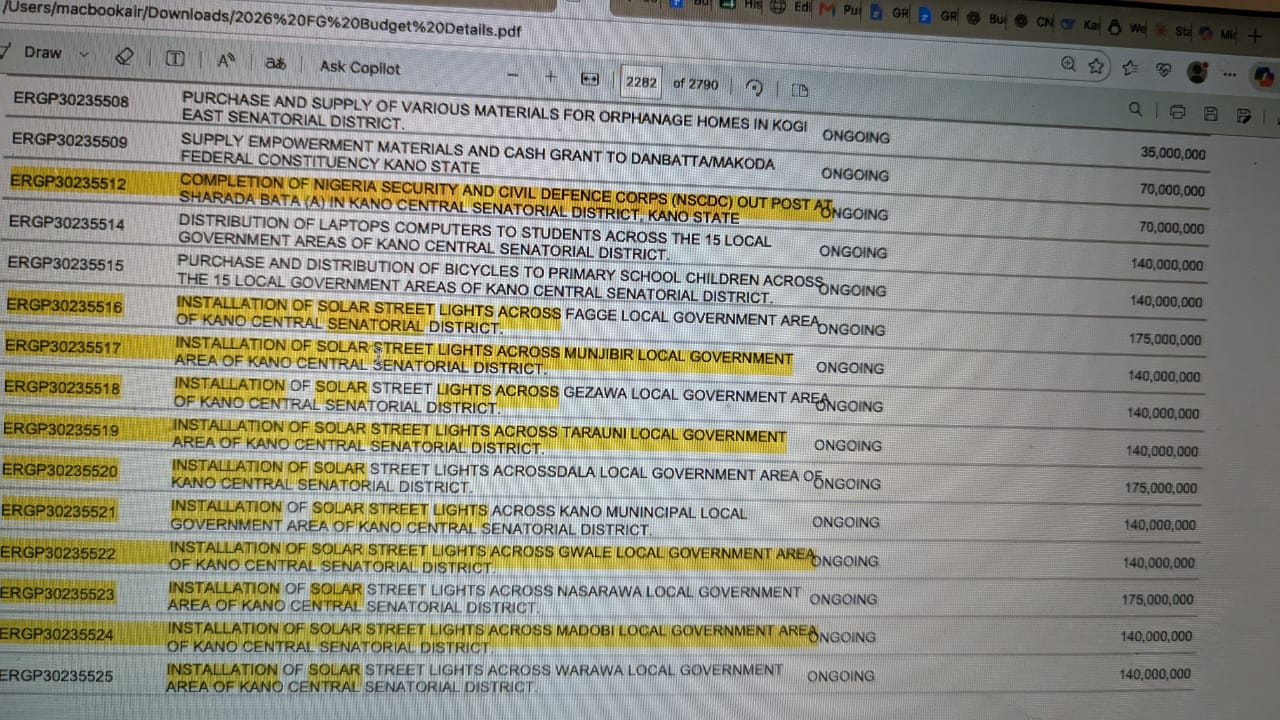
A breakdown of the capital budget shows that the Board allocated ₦210 million for the construction of the Dantata Road–Saint Louis Road in Kano Central Senatorial District and ₦70 million for a 1.5-kilometre road in Ugwolawo, Ofu Local Government Area (LGA) of Kogi State.
The Board also budgeted ₦84 million for the completion of factories in Kogi East Senatorial District and ₦70 million for the completion of a Nigeria Security and Civil Defence Corps (NSCDC) outpost in Sharada, Kano.
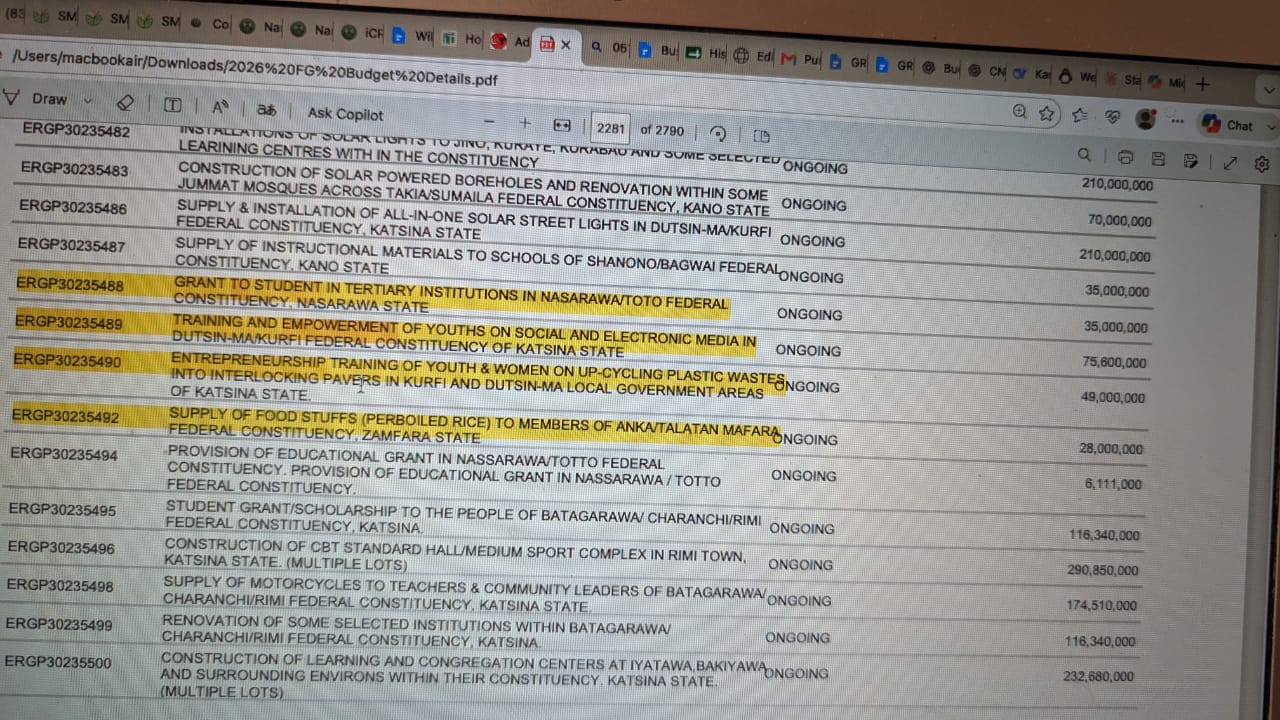
In Zamfara State, the budget provides ₦28 million for the distribution of parboiled rice to beneficiaries in Anka/Talata Mafara Federal Constituency.
Another ₦70 million was earmarked for empowerment materials and cash grants for residents of Danbatta/Makoda Federal Constituency in Kano State.
 ₦1.5 Billion For Solar Streetlights
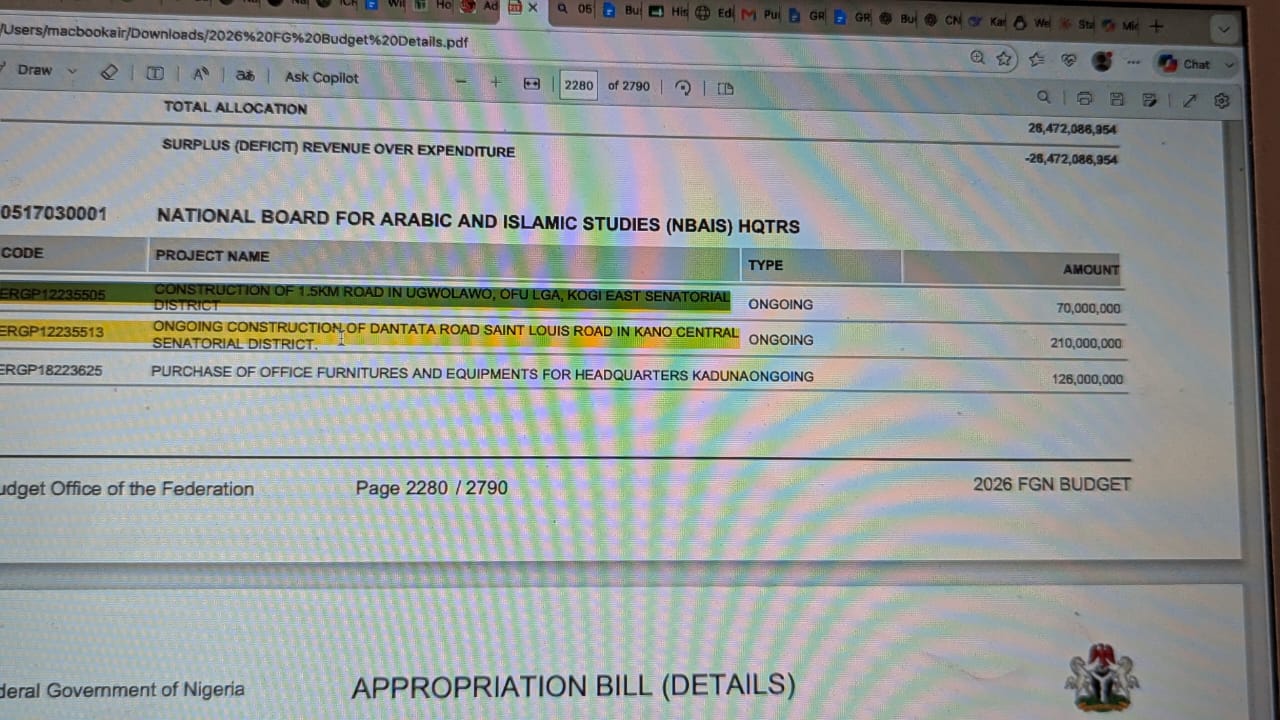
The largest share of the off-mandate projects is allocated to the installation of solar-powered streetlights across several LGAs in Kano Central Senatorial District.
The budget allocates ₦175 million each for Fagge, Dala and Nasarawa LGAs; ₦140 million each for Tarauni, Kano Municipal, Gwale, Gezawa, Madobi, Warawa and Munjibir LGAs.
The combined allocation for the solar streetlight projects exceeds ₦1.5 billion.
The Board also allocated ₦75.6 million for training youths on social and electronic media, as well as ₦49 million for entrepreneurship training for youths and women on converting plastic waste into interlocking paving stones in Dutsin-Ma/Kurfi Federal Constituency of Katsina State.
Questions Over Mandate
NBAIS is responsible for coordinating Arabic and Islamic education, accrediting schools, conducting examinations, developing curricula and issuing nationally recognised certificates in Arabic and Islamic studies.
According to information on its official website, the Board oversees the Senior Arabic and Islamic Secondary School Certificate Examination (SAISSCE), the Tahfeez programme and the Science stream, while ensuring the integrity of examinations and certification processes.
 Its statutory functions also include accrediting examination centres, verifying results and maintaining educational standards through digital certification systems.
However, road construction, solar streetlight installation, food distribution, youth empowerment schemes and security infrastructure do not form part of the Board’s legal mandate.
Accountability Concerns
Public finance experts have repeatedly criticised the growing practice of assigning constituency projects to specialised federal agencies, warning that it weakens institutional planning and accountability.
They argue that infrastructure projects such as roads should ordinarily be executed by the Federal Ministry of Works or relevant road agencies. Similarly, social intervention programmes, including food distribution, are expected to be implemented through agencies with the requisite mandate and expertise.
Analysts say using agencies outside their statutory responsibilities to execute such projects raises concerns over procurement oversight, project supervision and value for public funds.
They also warn that the practice diverts scarce resources away from agencies’ core functions and makes it more difficult to assess performance against their mandates.
WikkiTimes contacted NBAIS to explain how the projects align with its statutory responsibilities and whether the projects were introduced during the budget approval process.
When contacted for comments, a staff member of the National Board for Arabic and Islamic Studies (NBAIS), who identified himself as Ibrahim Manga, said he could not speak to the media without clearance from the Registrar.
During a follow-up phone conversation, Mr Manga said the Registrar had directed the reporter to seek clarification from the National Commission for Almajiri and Out-of-School Children Education (NCAOOSCE) instead.
However, when it was pointed out that the questioned projects were contained in the NBAIS’s own 2026 budget, Mr Manga declined to comment further, saying he was not authorised to grant interviews on the matter.
Source: WikkiTimes
